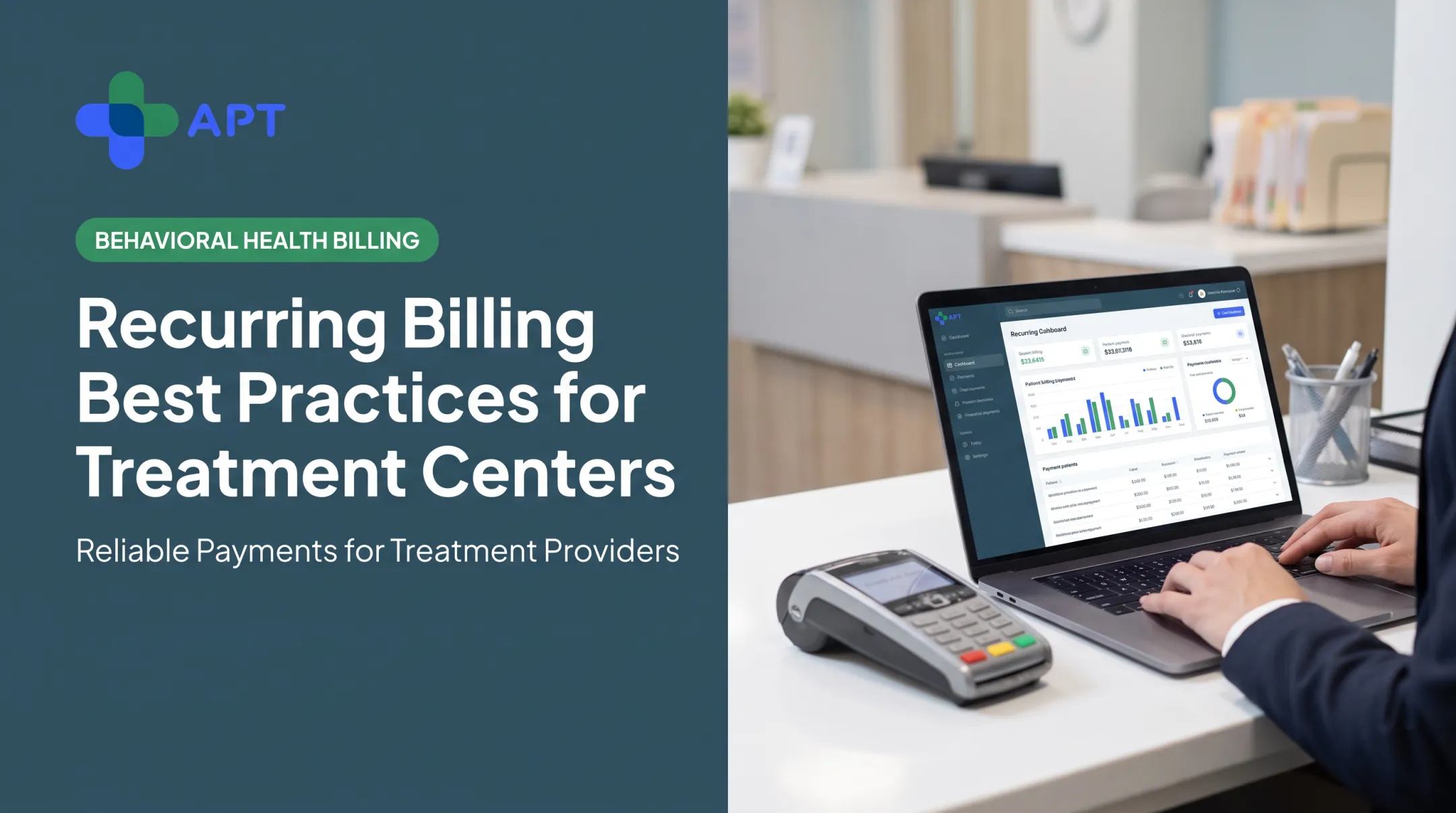

Recurring payments fix part of this. A patient authorizes a card or ACH account, and the center charges it on an agreed schedule. Billing becomes predictable without making care feel transactional.
This guide covers how to design a payment plan, choose payment methods and a processor, get authorization, protect payment data, and handle failed transactions.
Key Takeaways
- Recurring billing fits fixed fees, weekly plans, variable balances, and recovery housing.
- Offer card and ACH, with clear terms, documented consent, and easy cancellation.
- Judge processors on behavioral health experience, reporting, funding speed, security, and pricing.
- A defined failed-payment workflow cuts follow-up while keeping communication respectful.
What Recurring Payments Mean for Treatment Centers
A recurring payment is a pre-authorized card or bank-account charge on a set schedule. Under Mastercard's rules, recurring charges can be fixed or variable. Installments differ because they have a set number of payments and an end. A one-time payment is a single charge.
Where Centers Use Them
- Program fees and deductibles
- Self-pay balances
- Weekly or monthly outpatient care
- Session packages
- Sober-living or recovery-residence charges
Fixed vs. Variable
Fixed payments suit a defined monthly program fee or housing charge. Variable payments change when the level of care, session count, add-on services, credits, or outstanding balance changes.
Either way, tie the arrangement to a written payment plan. It should state:
- The amount or how it is calculated
- Billing frequency, start date, and expected end date
- The authorization and cancellation process
- How adjustments will be communicated
How Treatment Centers Can Set Up Recurring Payments
- Map your billing model. Automate fixed program fees, structured plans, and recurring outpatient services. Keep unpredictable charges in a manual review queue.
- Write the plan in plain language. Cover the amount or formula, billing dates, number of payments, what the payment covers, refund and credit handling, and what happens if treatment changes.
- Pick a processor and workflow. It should accept your preferred methods, store credentials through tokenized or hosted processes, and produce records for finance and patient-services teams.
- Collect explicit authorization. Record the payer's consent, payment method, schedule, amount or calculation, and modification and cancellation terms. Keep these records for reconciliation and disputes without storing raw card data in internal systems.
- Configure notifications. Send enrollment confirmations, receipts, upcoming-charge reminders, failure notices, and alerts when a plan changes or ends.
- Test before launch. Walk through each path before go-live:
- Enrollment, first charge, and recurring charge
- Declined card and failed ACH debit
- Refund, cancellation, and early completion
- Change in level of care
- Reconcile regularly. Compare successful, pending, declined, refunded, and disputed payments against your billing or practice-management records.

Authorization Details That Matter
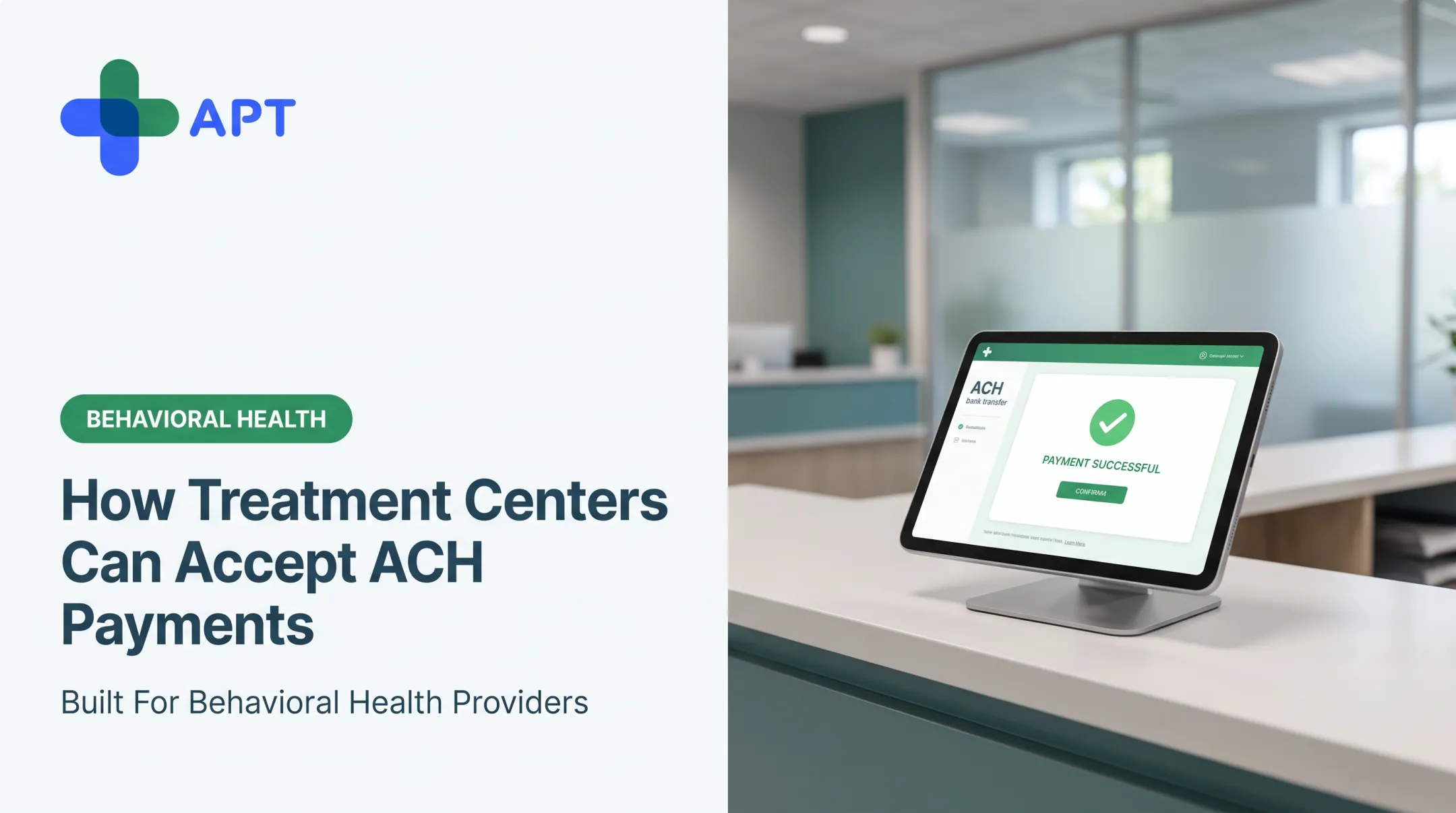
For ACH, Nacha's guidance calls for clear, readily identifiable authorization that is written and signed or similarly authenticated. Keep it for two years after termination or revocation, and give the payer a copy.
If a variable ACH amount changes from the prior debit, Regulation E generally requires 10 days' advance notice unless the payer opted into range-based notice. Payers can also stop a preauthorized transfer by notifying their bank at least three business days beforehand.
Card networks add their own rules. Visa requires consent, disclosure of material terms, and a simple cancellation process for recurring transactions.
Apt Financial is one processor to evaluate for behavioral health workflows. Evaluate its recurring card and ACH capabilities, virtual terminal, pay-by-link, reporting, funding timing, and support model against your operational needs.
Choosing Payment Methods and a Processor for a Treatment Center
Comparing Methods
- Cards: Convenient for card-on-file billing and program fees. Plan for expiration dates and declines.
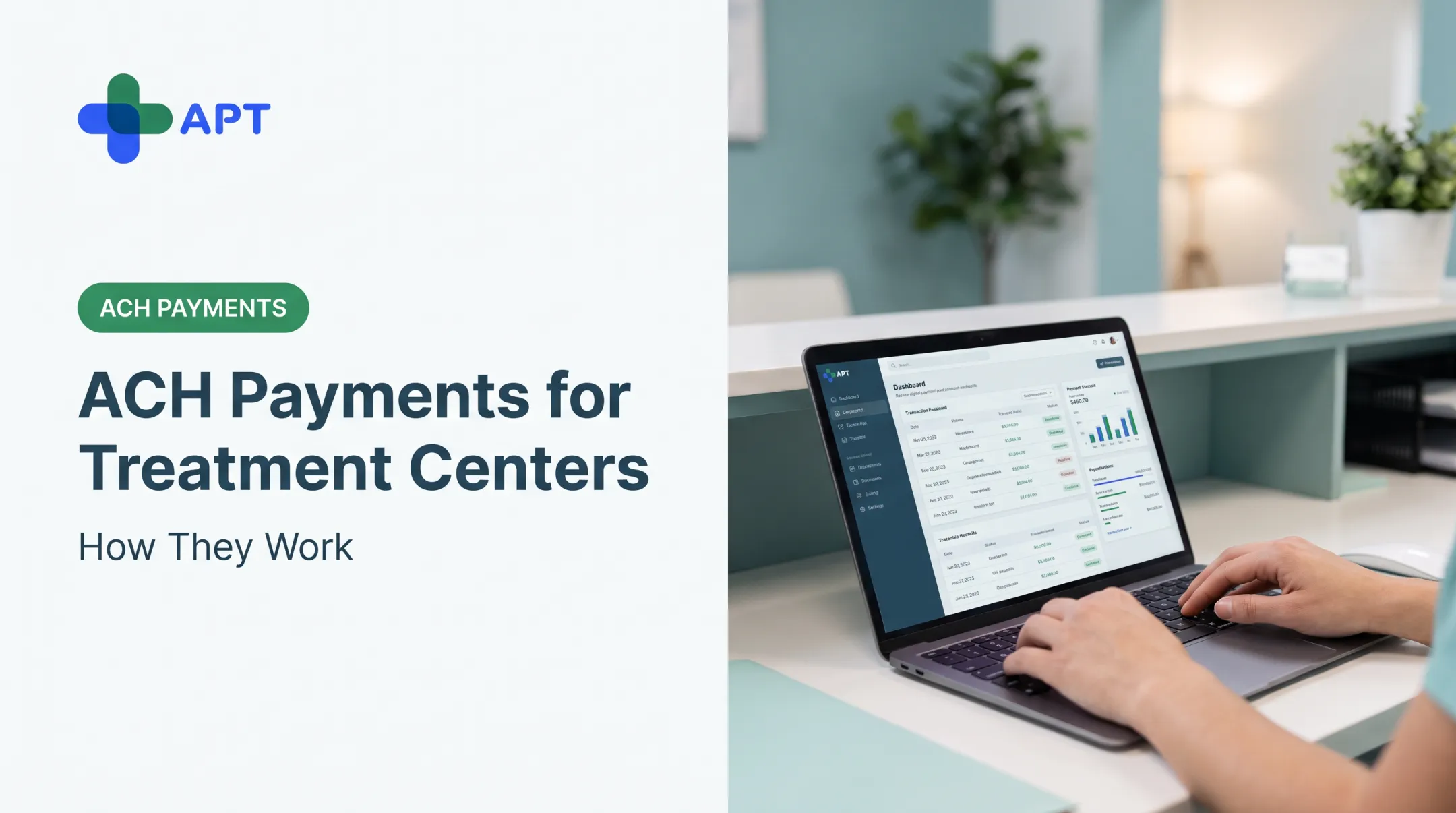
- ACH: Suited to larger or longer balances, often at lower fees than cards. Plan for settlement timing and returns. Common return codes include R01 (insufficient funds), R02 (account closed), and R03 (no account).
- Payment links and recurring invoices: Give payers a clear record and help with remote collection. Use a secure workflow, and pair links with autopay when you cannot rely on the payer to act each cycle.
Choose your mix by payment size, payer preference, predictability, settlement needs, and how much exception handling your staff can absorb. Many centers offer card for smaller recurring fees and ACH for large balances.
Processor Evaluation Checklist
- Billing: Recurring card and ACH, payment plans, variable amounts, refunds, retries, and scheduled end dates
- Security: Tokenization or card-on-file security, PCI DSS responsibilities, access controls, and audit records
- Channels: Virtual terminal, pay-by-link, in-person terminals, multi-location support, reporting, and exports
- Integrations: Accounting or practice-management compatibility
- Pricing and risk: Funding timing, transparent per-transaction pricing, contract terms, and chargeback support
- Support: Dedicated help for treatment-center cash flow
Surcharging
Surcharging is optional and tightly regulated. Visa allows it only on credit cards, capped at the lower of your acceptance cost or 3%, with advance notice and disclosures. Mastercard bars surcharges on debit and prepaid.
Some states, including Massachusetts, prohibit card surcharges. Verify network and state rules, and disclose clearly.

Apt Financial is built for treatment centers that need card and ACH acceptance, recurring billing, dashboard reporting, next-day card funding, multi-location support, and hands-on service. It offers no long-term contracts and supports compliant surcharging.
Compliance, Security, and Failed-Payment Management
Compliance Basics
Recurring billing rests on clear terms, affirmative authorization, accurate receipts, easy cancellation, and records of what the payer agreed to. Rules shift, so check current requirements.
The FTC's expanded 2024 click-to-cancel rule was vacated, and the FTC's 2026 action restored the narrower prior rule. Federal ACH, card-network, and state automatic-renewal rules still apply. Substance use records may also bring HIPAA and 42 CFR Part 2 into billing communications.
This article is general information, not legal advice. Have legal or compliance counsel review your final process.
Protecting Payment Data
- Use hosted payment pages, secure links, and tokenization
- Apply role-based access and strong account controls
- Never send card or bank details by email, chat, or text; PCI DSS prohibits transmitting unprotected card numbers that way
Outsourcing does not erase your responsibilities. Tokenization and hosted pages do not automatically shrink PCI scope. Apt Financial offers PCI DSS-compliant processing and P2PE tokenization for recurring billing. Confirm any provider's specific responsibilities, documentation, and controls before launch.
Building a Failed-Payment Workflow
- Identify the decline or return code.
- Send a clear, respectful notice.
- Offer a secure way to update the payment method.
- Retry only within processor controls and network rules. A generic decline is not permission to retry repeatedly.
- Escalate unresolved balances to trained staff.
Typical causes include:
- Expired cards or insufficient funds
- Wrong bank details
- Authorization problems or fraud screening
- Changes in a payer's finances
Card updater services from Visa and Mastercard can refresh changed card details automatically.
Handling Exceptions
When care changes, pause or revise the plan. Apply credits and refunds consistently, document cancellations, and reconcile every adjustment. Track these metrics over time:

- Approval rates and failure reasons
- Recovery outcomes
- Refunds and disputes
- Staff time on follow-up
Why Treatment Centers Use Recurring Payments
- Cash flow: Scheduled collection makes self-pay revenue easier to forecast and reduces dependence on checks and manual transfers.
- Less admin work: Automation limits repeated data entry, reminders, manual invoicing, and reconciliation.
- Better patient experience: Fewer missed due dates, card or ACH choice, digital links, and clear receipts.
Those gains matter because self-pay is widespread in this field. In SAMHSA's 2024 survey, 89.9% of facilities that accept client payments or insurance accepted cash or self-payment. That measures acceptance, not the share of revenue.
Balance the benefits with safeguards. Recurring billing should support a documented arrangement, never obscure the amount or timing of charges, and never replace a real conversation when a patient's treatment or finances change.
Frequently Asked Questions
How do I set up an automatic monthly payment?
Choose a recurring-capable processor, define the amount and schedule, and get documented authorization. Collect card or ACH details securely, configure receipts and reminders, and test before going live.
What's the best way to accept payment?
Most centers combine cards, ACH, and payment links. The right mix depends on payer preference, transaction size, predictability, cost, security, and reporting needs.
Can you use a credit card for recurring payments?
Yes, with proper payer authorization and a processor that supports secure card-on-file or tokenized billing. Plan for expiration dates, declines, receipts, and easy card updates.
Are recurring payments secure for treatment centers?
Security depends on the processor and your workflow. Use PCI DSS-aligned practices, hosted or tokenized collection, restricted access, secure communications, and documented authorization, then have compliance professionals review.
What happens when a recurring payment fails?
Identify the failure, notify the payer clearly, and offer a secure payment-method update. Apply controlled retries, document the outcome, and follow your policy for unresolved balances.