
Payment flexibility changes that equation. 58% of consumers say they'd switch providers for a better payment experience, according to InstaMed's annual report, and most now expect digital, self-service options for recurring bills.
Treatment-center payments carry extra complexity, too. Recurring charges, high-value balances, remote collections, and card-not-present risk all raise the stakes compared to a typical retail sale. This guide walks through choosing a setup, preparing for underwriting, launching each payment channel, protecting cardholder data, avoiding common mistakes, and evaluating a processor built for behavioral health.
Key Takeaways
- Map terminals, payment links, virtual terminal, recurring billing, and ACH to your billing workflow.
- Pick a processor that understands behavioral health, prices transparently, and backs you up with real support.
- Lock in PCI DSS controls, billing authorization, and staff training before the first card swipe.
- Compare total cost and operational fit, not just the advertised rate, for recurring and card-not-present payments.
How Treatment Centers Can Set Up Card Payments
Setting up card acceptance is a sequence of steps that determines whether patients can pay easily and whether your center gets funded on time.
Step 1: Map the Treatment Center's Payment Workflow
Before comparing processors, document how money actually moves through your center.
- List when you collect admissions deposits, program fees, deductibles, balances, and payment-plan installments
- Identify every channel you need: front-desk terminal, remote payment link, virtual terminal, phone-assisted payments, recurring card billing, and ACH
- Estimate monthly volume, average ticket size, refund frequency, number of locations, and staff users
- Keep patient-responsibility payments separate from insurance workflows. Card processing handles what patients owe you directly, not claims or eligibility
This map becomes the foundation for the underwriting conversation in Step 3.
Step 2: Choose a Processor and Account Structure
You'll typically choose between an all-in-one provider and a traditional merchant-account setup through an acquiring bank. Stripe's own explainer notes that Stripe's model combines processing and acquiring, so you don't need a separate merchant account. Traditional setups split those roles between a bank and a processor.
For treatment centers, category experience matters more than the org chart. Confirm the provider:
- Explicitly works with substance use disorder or behavioral health centers
- Can evaluate your services, billing model, and transaction sizes
- Supports major cards, ACH, recurring billing, payment links, and virtual terminals
- Offers multi-location administration and transaction reporting
Apt Financial, a Georgia-based processor, built its platform around substance use disorder treatment providers specifically. It pairs card and ACH processing with recurring billing, a virtual terminal, pay-by-link functionality, and in-person terminal options, plus dedicated support for treatment-center cash flow. Confirm current availability and terms directly before signing anything.
Step 3: Complete Underwriting and Connect the Settlement Account
Underwriting is where behavioral health centers often hit extra questions. Have these ready:
- Legal business name, tax ID, and ownership details
- Business bank account for settlement
- Expected processing volume and average transaction size
- Refund policy and a description of services offered
Facilities sometimes get flagged for additional review because recurring, higher-value, or card-not-present transactions carry more risk in an underwriter's eyes.
Before signing, confirm how reserves, funding holds, chargeback handling, and transaction limits work. Once approved, link the account to your business bank account and confirm the funding schedule and authorized users.
Step 4: Configure, Test, and Launch Each Payment Channel
Don't go live without testing every scenario first:
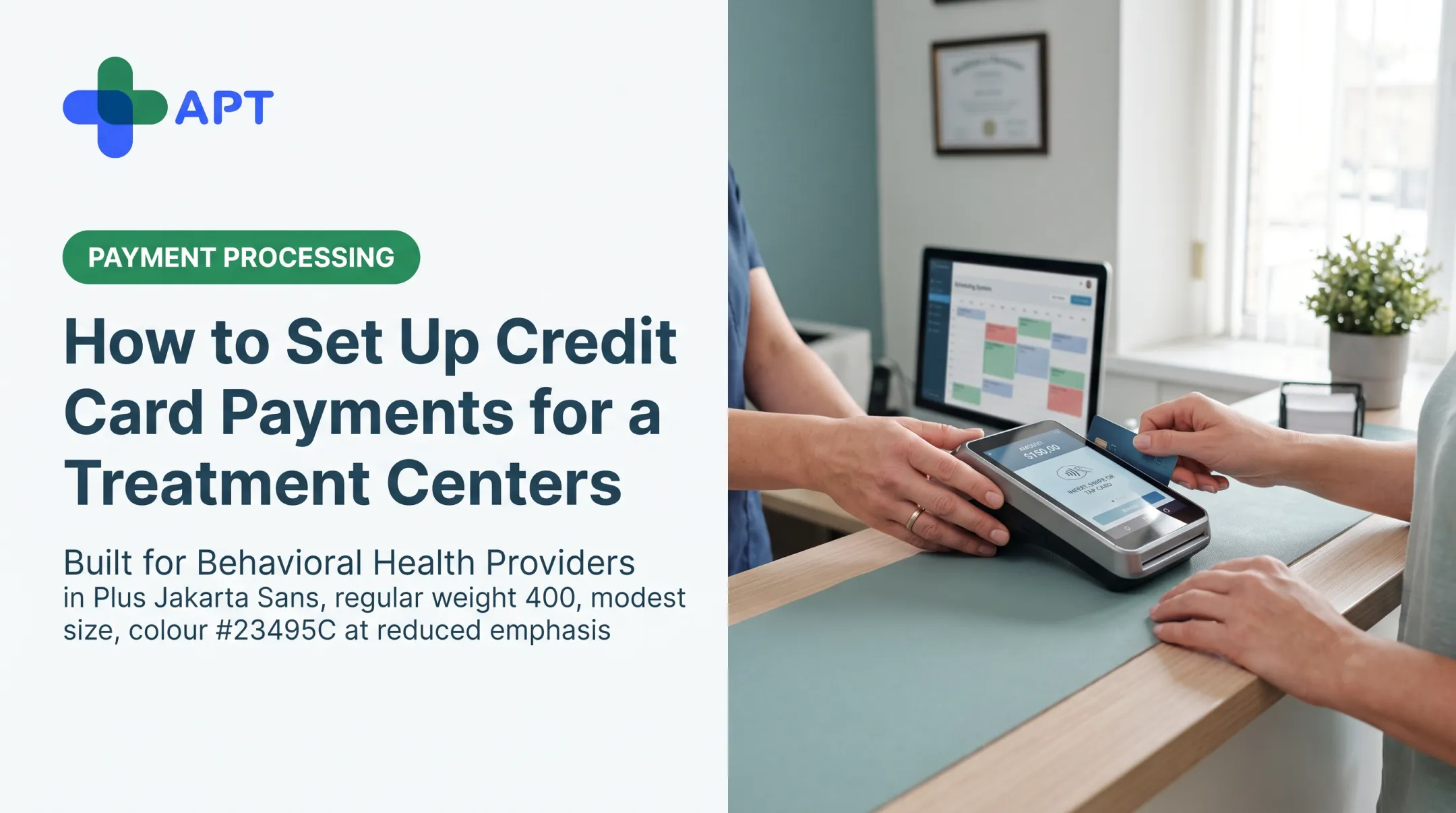
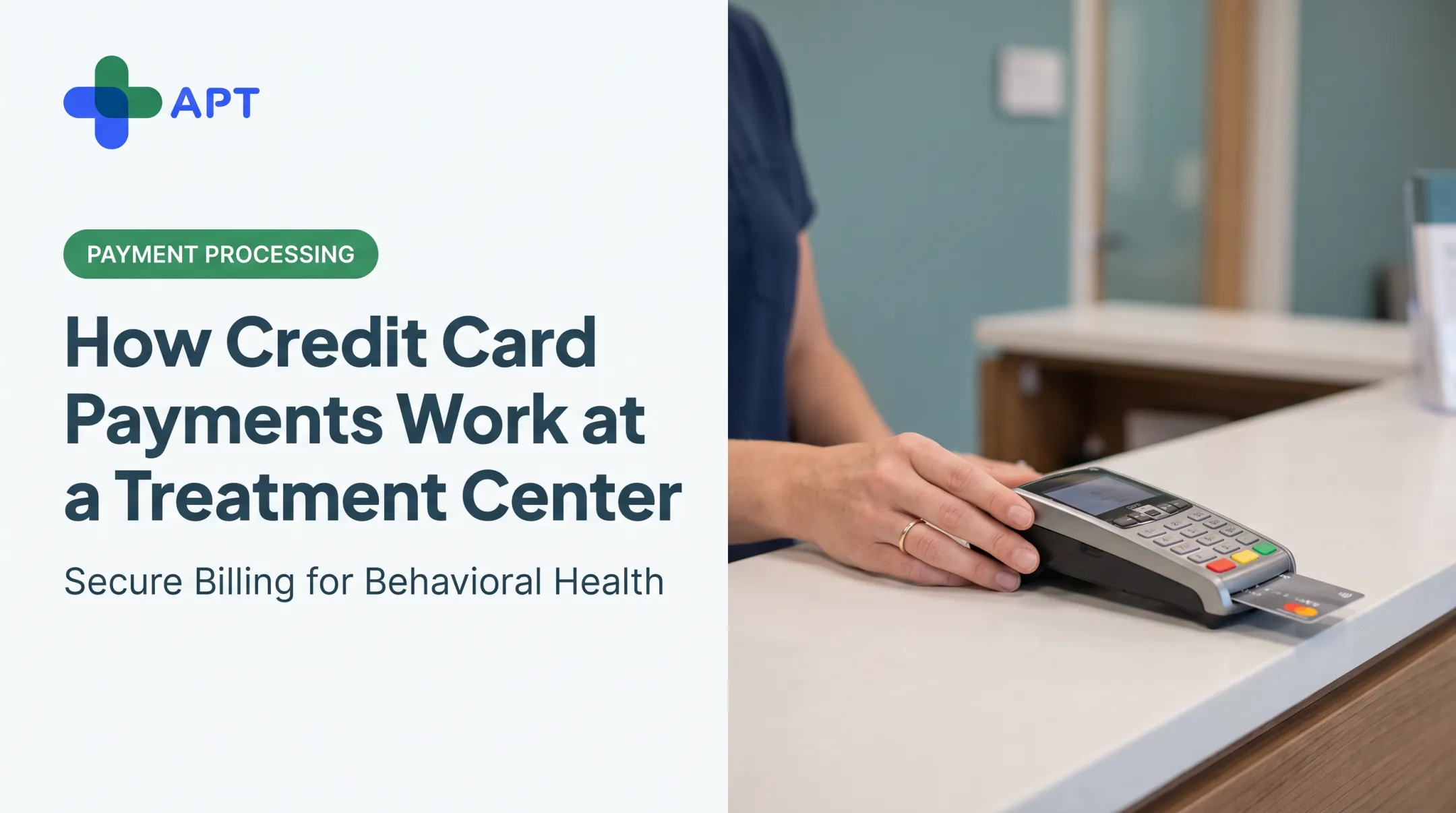
- Set up EMV-capable, contactless terminals for in-person payments
- Configure a secure virtual terminal for approved manual-entry use
- Enable payment links or hosted checkout for remote collection
- Build recurring billing only after documenting authorization, amount, frequency, and cancellation terms
- Test successful payments, declines, refunds, voids, failed recurring charges, and settlement deposits
- Train front-desk, billing, and management staff on permissions and refund approvals

When Card Payments Make Sense and What You Need
Card acceptance pays off most when a center collects deposits, self-pay fees, deductibles, recurring weekly or monthly balances, or payments from patients who aren't on-site. If your billing touches any of those scenarios, it's worth having the right tools in place rather than improvising case by case.
Equipment and System Requirements
Look for a system that covers:
- EMV and contactless terminal support
- Virtual terminal and secure payment links
- Recurring billing and ACH
- Dashboard reporting with role-based access
- Receipt delivery and compatibility with existing practice-management tools
Documentation and Policies to Prepare
Before launch, prepare:
- Business and banking documentation
- Written service descriptions
- Expected transaction patterns and refund/cancellation policies
- Billing authorization language for recurring charges
- A reconciliation process tying payments back to patient or account records
Staff Training and Compliance
Train staff on:
- PCI DSS responsibilities and approved devices
- Customer verification at the point of payment
- Refunds, disputes, and chargeback handling
- When and how to escalate suspicious transactions
PCI DSS governs how payment-card data is secured. It does not cover HIPAA, state privacy rules, consumer-protection law, or behavioral-health-specific regulations. Review those separately with qualified compliance or legal counsel rather than treating card-processing setup as a substitute for a full compliance review.

Key Variables, Common Mistakes, and Troubleshooting
Approval rates, successful collections, and dispute exposure all hinge on how a payment is taken, not just whether a card was accepted.
Transaction Type and Payment Channel
| Channel | Risk profile |
|---|---|
| Card-present (terminal, chip) | Lower fraud risk; eligible for EMV liability protections |
| Payment links / online checkout | Card-not-present; higher documentation needs |
| Manually keyed (virtual terminal) | Card-not-present; requires strong verification |
| Recurring card-on-file | Requires documented authorization and update procedures |
Billing Authorization and Recurring-Payment Controls
Before storing a card on file, Visa's guidance calls for a cardholder agreement that explains intended use, billing terms, and how to stop future charges. If the initial verification charge is declined, the credential can't be treated as stored.
Avoid these common missteps:
- Charging a card without documented permission
- Changing a recurring amount without notifying the patient first
- Using a vague billing descriptor patients won't recognize on their statement
Security, Staff Access, and Data Handling
- Use only PCI-approved devices and validated payment systems
- Limit cardholder-data access by staff role
- Never store card numbers on paper or in unencrypted files
- Review account activity regularly, even when your processor manages most technical controls
Mistakes and Troubleshooting
| Issue | First step |
|---|---|
| Declined payment | Check card details, available funds, and AVS/CVV match |
| Failed recurring charge | Confirm expiration date and retry per your documented process |
| Missing deposit | Check funding schedule and any pending reserve hold |
| Unexpected fee | Review the monthly statement line by line |
| Chargeback | Pull transaction records and respond within the deadline |
Review your dashboard and statements monthly to reconcile attempted, successful, refunded, and disputed transactions by location.
Keep a clear escalation path for suspected fraud or repeated declines. Preserve transaction records without holding onto unnecessary card data.
Alternatives to Accepting Card Payments
Cards rarely work alone. Most treatment centers combine several methods depending on patient preference, balance size, and whether payments are recurring.
ACH Payments
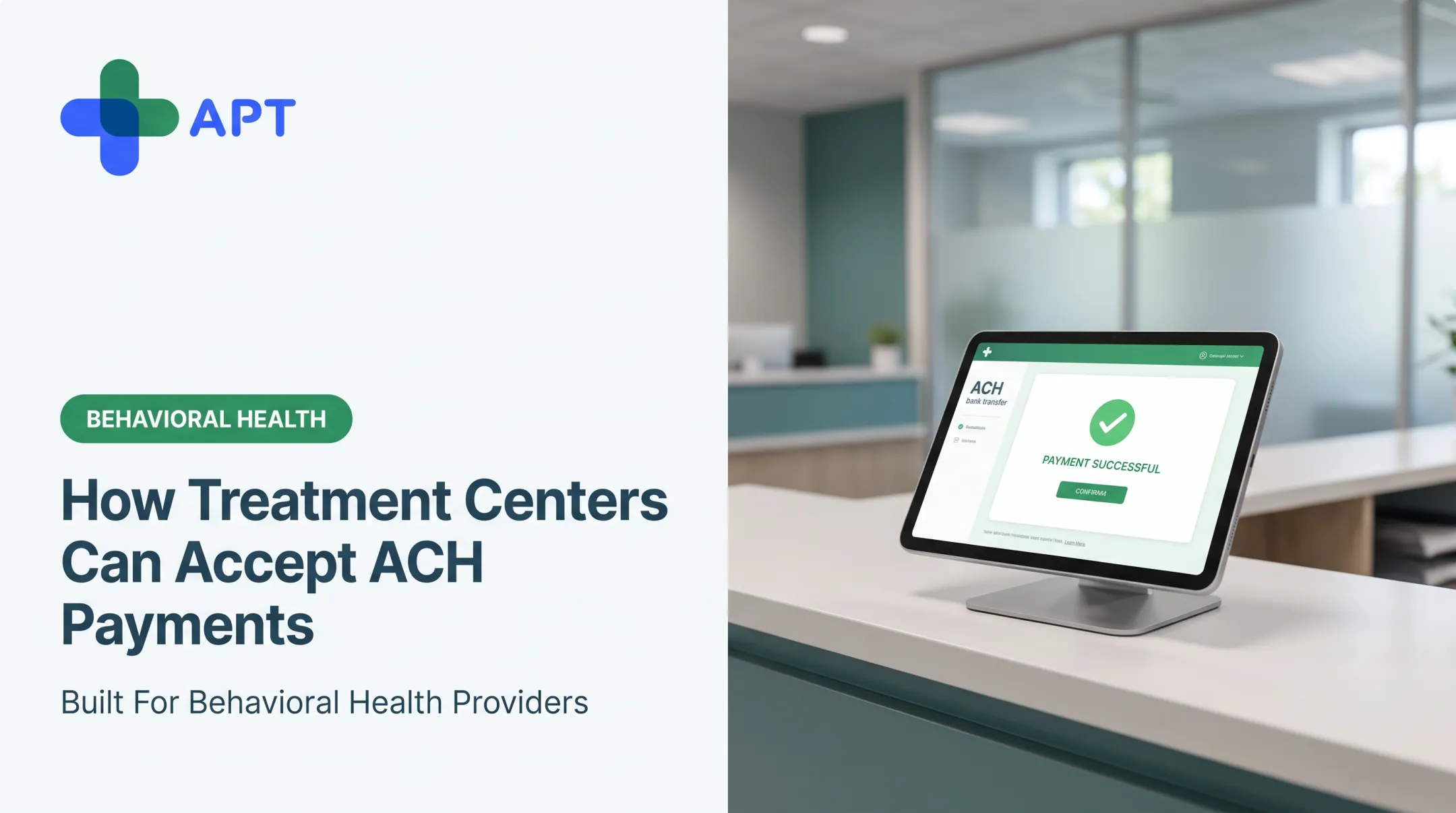
ACH works well for larger balances or payment plans where patients prefer paying from a bank account instead of a card. Nacha reports that 80% of ACH payments settle in one banking day or less. Trade-offs include authorization requirements, return risk, and separate reconciliation from your card transactions.
Payment Links and Invoices
Secure links and electronic invoices reduce the need to take card numbers over the phone. Verify the recipient's identity, set expiration windows, and confirm how refunds and payment status show up in your reporting.

Checks, Cash, and Third-Party Payment Apps
- Checks require manual posting and slow reconciliation
- Cash increases handling risk and leaves thinner audit trails
- Peer-to-peer apps often lack the documentation, reporting, and dispute controls a treatment center needs
Conclusion
Treatment centers can accept card payments through a combination of terminals, secure payment links, a virtual terminal, recurring billing, and ACH. The right setup depends on your billing model, patient mix, and compliance responsibilities, not just which processor advertises the lowest rate.
Processor experience, transparent pricing, reliable funding, reporting, and staff controls matter just as much as basic card acceptance. Apt Financial offers behavioral-health-focused card and ACH processing with recurring billing, next-day settlement, and hands-on support built around substance use disorder treatment centers. Verify current capabilities and request a tailored review before you commit.
Frequently Asked Questions
What is the most affordable way to accept credit card payments?
Affordability depends on transaction type, average ticket size, volume, and whether you need recurring billing or ACH. Compare the total effective cost and contract terms across processors rather than choosing based on the advertised rate alone.
How do I accept credit card payments?
Choose a processor, complete underwriting, connect your settlement bank account, and configure your terminal or payment links. Test transactions, confirm PCI DSS readiness, and train staff before going live with deposits and recurring balances.
What is the easiest way to accept credit card payments?
An all-in-one processor with terminals, payment links, and recurring billing in one dashboard typically simplifies setup. Still confirm the provider has behavioral-health experience and can support your underwriting needs.
What app allows me to accept credit card payments?
Most processors offer an app or dashboard for mobile and terminal payments. Prioritize secure account controls, staff permissions, refunds, recurring billing, and PCI DSS support over app convenience alone.
Can Zelle accept credit card payments?
No. Zelle's business FAQ describes it as a transfer service between eligible bank accounts, not a way to accept a customer's credit card. Treatment centers need card or ACH tools built for business payments instead.